In-Line Versus Final Inspection for Premium Handbags: What Each Catches, and What Each Costs
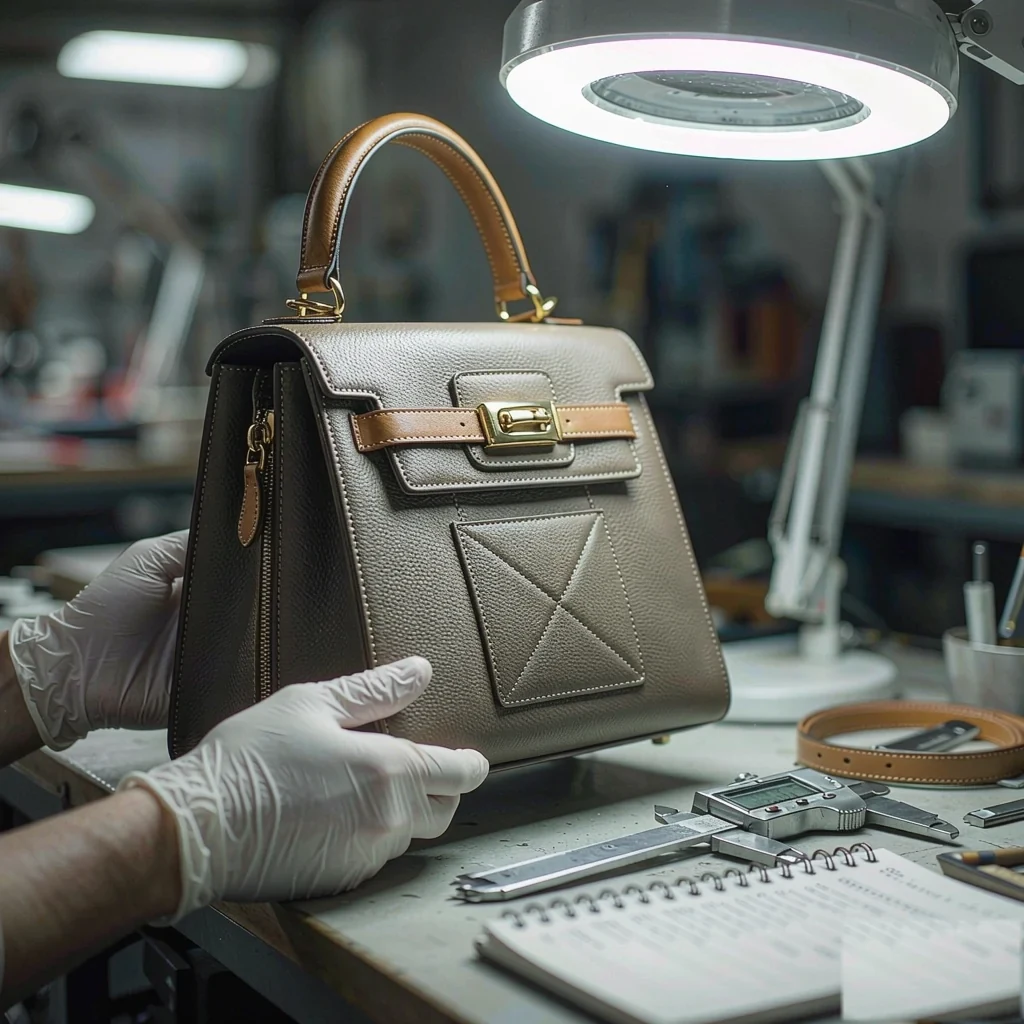
Are in-line and final inspection the same control at two moments, or two different controls? They answer different questions. In-line asks whether the operation is drifting right now, so it is frequent, small and anonymous; final inspection asks what the client would receive, so it is slower, statistical and contractual. On a 500 pcs style the final draw is fixed at code letter H, 50 units, accept 3 and reject 4. Everything the draw cannot reach has to be caught earlier, on the bench, while it costs one rather than twelve.
Two Questions, Two Answers, One Programme
Treating these as one thing is why programmes with good paperwork still ship weak goods. The in-line check is a measurement taken during the operation, aimed at drift; it needs no statistics because every reading is actionable on its own. The final draw is a judgement made on a population, aimed at the shipment; it needs statistics because the client cares about what was missed, not what was measured. Mix them and you get either a very expensive bench or a very powerless audit.
| Dimension | In-line inspection | Final inspection |
|---|---|---|
| Question asked | Is this operation drifting right now? | What would the client receive? |
| Unit examined | The unit on the bench, plus a first-piece sign-off | A random draw from the finished lot |
| Sample size | 1 unit per 50 running, plus a roving check every 2 hours | 50 units from 500, code letter H |
| Decision produced | Adjust the machine, needle or pattern | Accept, rework or reject the lot |
| Record kept | Reading against operation and position | Tally by defect code against drawn units |
| Calendar cost | Absorbed inside the run, no added days | Three days reserved for correction and re-check |
| Failure consequence | Correct immediately and continue | Stop the shipment and draw again |
What In-Line Inspection Catches That Nothing Else Can
Three groups of failures are only visible while the work is in motion, because afterwards the evidence is gone. Once a seam is closed you cannot see whether the reinforcement sat over the load path; once an edge is built you cannot tell how thick the fold was underneath it; once panels are joined you cannot check whether the grain ran consistently. These are hidden-read faults, and no amount of final scrutiny recovers them.
- Fold thickness after skiving, read at 0.6-0.8 mm before the panel is turned.
- Reinforcement placement, confirmed centred over the load path before the face goes on.
- Grain direction, checked on every panel of one unit while the pieces are still loose.
- Stitch tension on the machine itself, taken before 500 metres of seam have been run.
- Adhesive open time, since joints closed outside the window look right and separate later.
- Surface faults missed by the marker, recaptured at the cutting table rather than at the draw.
The tensile guilty party in that list is usually open time. A joint bonded outside the window passes every visual check, survives the audit, and fails in the client's hands three weeks later, which is precisely the failure that destroys a second order rather than merely costing a repair.
What Only the Final Draw Can Settle
The bench knows nothing about populations. It cannot tell you whether the fiftieth unit looks like the first, whether one colourway drifted against another in the same shipment, or whether the packing list matches the cartons. Those are distribution questions, and they need a random draw made after everything is finished, laid together under one light, read by someone who did not make it.
- Consistency across the whole lot, since a good first piece never proves a good last one.
- Colourway agreement between styles packed in the same shipment.
- Packing accuracy: carton counts, carton marking and document reconciliation.
- Presentation faults that only appear when units are set side by side under one lamp.
- Fit and function of closures, straps and feet, exercised as the client would use them.
- The contractual record itself, which is the artefact a retailer will eventually ask for.
A Sampling Rhythm That Actually Gets Kept
Frequencies fail when they are too fine for the rhythm of the work. A request to inspect every twelfth unit will be honoured for two days and then quietly abandoned, whereas one in fifty plus a roving sweep survives because it fits how a bench actually moves. Write the numbers down, post them at the position, and make it a person's named job rather than a general obligation.
- First-piece sign-off
- Every machine set-up, cleared within 30 minutes of the line starting
- Running sample
- 1 unit per 50 on each active station, readings taken at the position
- Roving sweep
- One full-circuit check every 2 hours per active line
- Shift handover
- Open findings read across between shifts before tools are put away
- Escalation trigger
- Two identical findings within one station in one shift
- Final draw
- 50 units from a 500 pcs lot, code letter H, accept 3, reject 4
Cost Compared: Correction and Calendar
The honest way to compare the two stages is to price the same fault at both moments. A seam allowance that wanders costs a minute at the bench and a re-sort of finished goods at the draw, and the ratio between those two numbers is why a programme should always spend on in-line before it spends on a bigger final sample.
| Fault | Caught in-line | Caught at final draw |
|---|---|---|
| Wandering seam allowance | Reset guide, one panel | Re-sort the lot, re-stitch, re-press |
| Fold left too thick | Re-skive one panel set | Rebuild edge and risk corner failure |
| Wrong reinforcement position | Reposition before closing | Unit unsaleable, no safe correction |
| Adhesive open time exceeded | Re-bond while the joint is fresh | Latent separation after delivery |
| Panel mis-matched in grain | Re-cut one panel | Visible stretch difference across the face |
Relative to a single panel corrected at the bench, the same finding intercepted at the draw runs roughly twelve times the cost once handling, re-sorting and re-packing are counted. The final draw remains essential; it is simply the wrong place to discover something.
Where the Two Stages Disagree
Disagreement is normal and useful: the bench sees individual units, the draw sees a population, and when they reach different conclusions something real has been learned. What matters is having a rule for settling it before it happens, rather than discovering during a tight shipping window that nobody agreed who decides.
- Write the numeric target first: a bench passes on the stated figure, not on how the piece looked.
- Where the two conflict, the sealed approval sample governs both.
- Escalate to re-measurement with a second gauge rather than to a discussion about taste.
- Record the disagreement itself, since recurring conflicts point at an ambiguous specification.
- Never resolve a conflict by relaxing whichever standard is cheaper that week.
Running Both on One 500 Piece Style
A mid-size structural style in calfskin with metal fittings is the common case, and it shows how little extra work the bench check actually adds once it is designed into the flow. Four moments carry the whole structure, and none of them extend the calendar because each happens inside an operation that would run anyway.
Set-up clearance
The first piece off each machine is read by the line leader within 30 minutes and signed against the pack. Nothing else starts until that signature exists, which is why set-up errors never reach fifty units.
Bench sampling
One unit in fifty is read at the position across seven lines, with stitch density counted over a 25 mm gauge and fold thickness checked with a dial gauge before turning. Findings are logged against the operation rather than the individual.
Roving sweep
A full circuit every two hours checks upstream conditions the operator cannot see: adhesive pots, thread tension, lamp colour temperature and the condition of cutting dies as they dull through a shift.
Final draw
Fifty units are taken at random from the finished lot, judged by code against the sealed reference, with three days reserved afterwards for correction and re-check before anything is cartoned.
Which Stage Deserves Money First
Asked to choose, spend on the bench. Enlarging a final sample from 50 units to 125 buys modest statistical improvement at real cost, while adding one disciplined measurement during assembly removes entire failure families from ever reaching the draw. The draw is a gate; it should not be your filter.
- Buy duplex pressure feet and edge gauges before you buy a larger final sample.
- Pay for one named person per line rather than shared responsibility across lines.
- Keep a calibrated gauge at the position, since an uncalibrated one reads whatever suits the hour.
- Fund photography at in-line findings, because the image stops arguments later.
- Keep laboratory spend for named lots, since certificates cannot be issued retrospectively.
One File or Two
Keep one file. A lot eventually produces a single question — ship or not — and answering it from two disconnected records invites exactly the gap that the two stages were meant to close. In-line readings sit at the front of the file in the order they were taken, the draw sits at the back with its decision line, and each carries the same lot identity so they can be read together by anyone with no prior knowledge.
- Lot identity
- Shared across every page, including style, colourway and order reference
- In-line section
- Set-up clearances, running readings and roving sweeps in time order
- Final section
- Draw plan, unit numbers, tallies by code and signed decision
- Photographs
- Indexed to the finding they illustrate, whether taken on the bench or at the table
- Gap record
- Any period where a scheduled check was missed, stated rather than omitted
How Both Are Costed on Our Programmes
In-line checks are designed into the operation rather than billed as a separate activity, so they add days to nothing; the final draw carries three reserved days for correction and re-check inside the 35-50 day bulk window. Documentation handling for the combined lot file starts at USD 4.80, covering assembly rather than laboratory work. Our validated partner factory Quanzhou Yingming Bags, an SGS-validated site, has run export programmes since 2014 across 7 production lines at about 200,000 pcs per month, with 500 pcs per style and colourway as the minimum order quantity.
See how both stages run on your style
Tell us the construction, the quantity and where the goods ship. You receive the in-line frequency sheet for your style, the final draw plan for your lot size, and the combined file structure used on our export programmes. Request a quote.
Frequently Asked Questions
What is the difference between in-line and final inspection?
In-line inspection measures work while it is being made and is aimed at drift, so every reading is actionable on its own. Final inspection draws a random statistical sample from finished goods and decides whether the lot ships. One controls the process, the other controls the shipment, and a programme needs both working from the same numeric targets.
How often should in-line checks happen?
Often enough to fit the rhythm of the work and no more. A practical rhythm is a first-piece sign-off cleared within 30 minutes of start-up, one unit read per fifty on each station, and a full-circuit roving sweep every two hours. Frequencies finer than that tend to be abandoned within days because they cannot be sustained alongside production itself.
Can in-line inspection replace the final draw?
No. Bench checks see individual units and cannot answer distribution questions such as whether the last unit matches the first, whether two colourways agree in one shipment, or whether carton counts are correct. Those need a random draw made after everything is finished and read under one light by someone who did not make the goods.
Why are some faults impossible to correct after assembly?
Because the evidence disappears once the unit closes. Reinforcement that missed the load path cannot be repositioned without dismantling the bag, and a joint bonded outside the adhesive open time looks correct and separates weeks later. Both are economical to fix at the bench and effectively unrepairable once discovered at the draw.
How much time does the final draw add to a schedule?
The draw itself takes under a day on a 500 pcs lot, but three days are reserved afterwards for correction and re-check. Those three days sit inside the 35-50 day bulk window rather than on top of it, which is why we plan them at sampling rather than discovering them during a shipping week.
Does in-line inspection slow production down?
Designed properly it does not, because readings are taken inside operations that would run anyway. A first-piece sign-off prevents fifty units being made wrong, and a two-minute roving sweep catches adhesive pots and dulling dies before they generate faults. The alternative is slower: correcting finished goods at the draw rather than resetting a machine.
Who should own the in-line readings?
A named person per line rather than a general obligation shared across lines. Findings should be logged against the operation and the position, not against an individual, because the record has to stay useful when staffing changes. Shared responsibility reliably becomes responsibility held by nobody within one busy month.
What is acceptance quality limit used for if in-line exists already?
It governs the final draw and describes the tolerable process average across a continuing series of lots, not perfection in any single one. At AQL 2.5 under ISO 2859-1 general level II, a 500 pcs lot uses code letter H, drawing 50 units with acceptance on 3 findings and rejection on 4.
How do you settle a disagreement between the two stages?
Refer to the numeric target written in the pack and then to the sealed approval sample, which governs both sides. Where the two still conflict, re-measure with a second calibrated gauge rather than debating appearance, and record the disagreement itself, since recurring conflicts usually mean the specification is ambiguous rather than wrong.
Should in-line and final records be kept together?
Yes, in one file under one lot identity. A lot eventually produces one question, ship or not, and answering it from two disconnected records recreates the gap the two stages were designed to close. Readings go at the front in time order and the draw at the back with its signed decision line.
What do hidden-read faults cost to correct?
Relative to one panel corrected at the bench, the same fault caught at the final draw costs roughly twelve times once handling, re-sorting and re-packing are counted. Two families in that group, misplaced reinforcement and adhesive applied outside its open time, cannot be corrected at all once the unit is closed and either reject or fail later.
Where should a new label spend its quality money first?
On the bench. Adding one disciplined measurement during assembly removes whole failure families from reaching the draw, whereas enlarging the final sample from 50 to 125 units buys modest statistical gain at real cost. Buy gauges, clear first-piece discipline and one named owner before buying a larger sample size.
What is included in the quality file fee?
Documentation handling from USD 4.80 per lot file covers assembly of the combined record: set-up clearances, running readings, roving sweeps, the draw plan with unit numbers, tallies by defect code and photographs. Laboratory testing is quoted separately and should be booked when the material lot is named, since certificates cannot be issued retrospectively.
People Also Ask
Is in-line QC the same as final QC?
No. In-line controls the process by measuring work while it is made; final controls the shipment by drawing a statistical sample from finished goods. Both are needed because one sees individual units and the other sees the population, and neither can substitute for what the other reveals.
How many units are inspected during line checks?
A workable rhythm is one unit per fifty per station, plus a first-piece sign-off cleared within 30 minutes of start-up and a roving sweep every two hours. Denser frequencies tend to be dropped within days because they cannot be sustained alongside the work itself.
Which handbag faults must be caught during assembly?
Fold thickness after skiving at 0.6-0.8 mm, reinforcement centred over the load path, grain direction consistent across panels, stitch tension set before long runs, and adhesive open time respected. None of these can be verified after the unit closes.
How long does a final inspection take?
Under a day for a 500 pcs lot, with three further days reserved for correction and re-check before cartons close. Those three days sit inside the 35-50 day bulk window, so they belong in the plan agreed at sampling rather than discovered during a shipping week.
What is cheaper, more in-line checks or a bigger final sample?
More in-line checks. Adding one disciplined measurement at the bench removes entire failure families before they reach the draw, while increasing the final sample from 50 to 125 units only modestly improves statistical confidence and costs considerably more per lot.
Sources and further reading
Every figure on this page is either our own programme data or attributed below. Open the originals before you write them into a specification.
- ISO — International Organization for StandardizationISO Publisher of ISO 2859-1, which fixes the sample size code letters, accept and reject numbers, and the switching procedures used for final lot draws.
- ASQ — Acceptance sampling resourcesASQ Practitioner material on when statistical sampling applies and when continuous process measurement is the more effective control.
- National Institute of Standards and TechnologyNIST Guidance on measurement traceability and calibration of the dial gauges and thread counters used for in-line readings at the bench.
- ISO 18454 — Colour and fastness test conditionsISO Specifies light booth and viewing conditions used when comparing units and colourways side by side at the final draw.